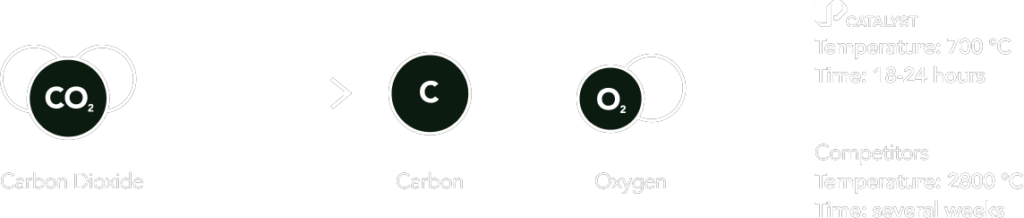
UP Catalyst production process requires 40% less energy than conventional synthetic graphite production, and 90% less energy for carbon nanotubes. Our feedstock is CO₂, one of the cheapest and most widely available carbon sources, instead of petroleum needle coke. The whole process runs at a single site, without the chain of refinery, calciner and graphite producer that conventional graphite depends on. This keeps our material costs competitive with fossil-based carbon materials, with no green premium.

UP Catalyst graphite is validated as battery grade. In independent testing, its discharge capacity is comparable to commercial graphites, and it supports fast charging. A European automotive manufacturer has confirmed its promising electrochemical performance. Our multi-walled carbon nanotubes show higher powder conductivity than most common commercial MWCNTs in third-party tests. In LFP cathodes, they gave 9% higher capacity retention during a 30-minute fast charge.

Local graphite production near battery facilities boosts supply chain resilience by reducing reliance on dominant market producers. This localisation shortens supply chains, mitigating geopolitical and trade disruption risks. UP Catalyst’s flexible process supports regional implementation, enhancing supply security.

Unlike synthetic and natural graphite, UP Catalyst's graphite uses renewable forestry byproducts, achieving a negative carbon footprint through CO₂ sequestration. Its production emits far less CO₂ than synthetic (25–35 t CO₂/ton) and natural graphite (10–15 t CO₂/ton) and avoids destructive open-pit mining. It also eliminates the use of harmful chemicals like hydrofluoric acid in purification.

UP Catalyst's approach uses off-the-shelf equipment, making it highly scalable and reducing both technological risk and capital costs. This enables quick deployment and expansion of production facilities. The use of proven equipment enhances process reliability and simplifies maintenance and upgrades.

UP Catalyst graphite offers significant economic and strategic benefits, enabling onshoring in Europe and North America, in line with the EU's Critical Raw Materials Act and the US Inflation Reduction Act. This fosters job creation in sustainable industries and strengthens local battery supply chains. Additionally, biographite helps OEMs and nations reduce Scope 3 emissions, supporting broader sustainability goals.